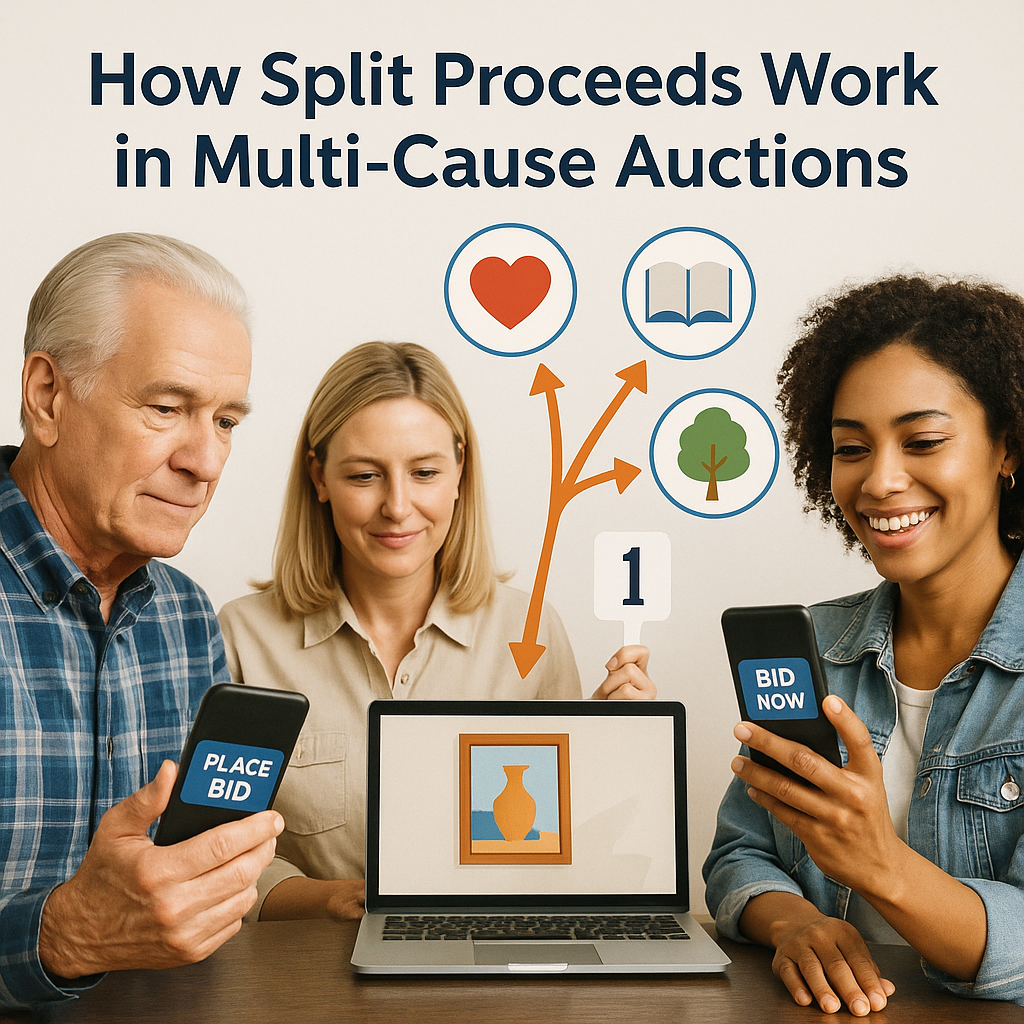
Many nonprofits run auctions that benefit more than one organization. This could include joint school initiatives, partner charities, or community groups collaborating on a shared event. Multi cause auctions expand impact, but they also increase financial complexity. Each beneficiary needs accurate reporting, correct payouts, and clear documentation.
Modern auction platforms simplify this by offering split proceeds features that track revenue at the item level. Instead of managing spreadsheets or reconciling multiple payment flows manually, the system calculates the distribution automatically. This ensures fairness, reduces errors, and increases transparency for donors and beneficiary organizations.
Run Multi Cause Auctions With Automated Split Proceeds
CharityAuctions calculates revenue distribution automatically so every organization receives accurate payouts with no extra work.
Visit CharityAuctionsWhy Multi Cause Auctions Need Split Proceeds Tools
1. Accurate Item Level Revenue Distribution
Every item in the auction can be assigned to one or more beneficiaries. The platform then distributes funds based on preset percentages or rules. This eliminates manual calculations and ensures each organization receives the correct amount.
Clear and accurate payouts build trust across partner organizations and donors.
2. Unified Payment Processing for All Beneficiaries
Rather than requiring donors to pay separate beneficiaries manually, the platform processes all payments through a unified system. This keeps the donor checkout experience smooth and reduces friction.
To understand how integrations support this, review:
- Easy integration of payment processors with auction platforms
- Smooth payment experience for auction donors
3. Clear Reporting for Each Organization
Multi cause auctions often require each beneficiary to submit separate financial summaries or tax filings. Split proceeds reporting organizes results by cause, making it easier for each organization to track revenue from their assigned items.
This also ties into compliance workflows, especially for events involving Canadian organizations. Supporting resources include:
4. Secure Payment Tools Reduce Administrative Risk
Because all payments flow through a single processor, fraud checks, identity verification, and checkout protections apply consistently across the whole event. This reduces the risk of invalid payments or disputed transactions.
More on this can be found in:
5. Built In Support for Multi Currency Events
Some multi cause auctions include international participants or Canadian donors. Multi currency support ensures that donations convert correctly and that beneficiaries see accurate financial summaries in their accounting workflows.
See:
6. Streamlined Checkout for Donors
Even with multiple beneficiaries, donors complete a single invoice with one payment. This keeps the process simple and avoids confusion about which organization the payment is going to. The platform handles distribution behind the scenes.
This unified approach is also used when integrating auctions with text to give tools.
Benefits of Split Proceeds for Nonprofits and Partner Organizations
Multi cause auctions, when supported by the right tools, offer several advantages:
- Greater fundraising reach and shared audience engagement
- Fair and transparent distribution of funds
- Less administrative burden after the event
- Stronger donor trust through accurate reporting
- Consistent security across all payment flows
- Ability to support multiple missions without complex logistics
Platforms that support split proceeds make collaboration safer and easier for nonprofits, schools, and community groups.
Frequently Asked Questions
What does “split proceeds” mean in a multi-cause auction?
It’s when revenue from items, donations, or fees is allocated across two or more beneficiary organizations by a rule you define—by percentage, per-item routing, or donor choice at checkout.
What are the most common split rules used by nonprofits and coalitions?
Flat percentage (e.g., 60/40), per-item beneficiary (each lot maps to a cause), donor-directed at checkout, tiered by category, or a hybrid (percent split plus per-item overrides).
Can each auction item be assigned to a different beneficiary organization?
Yes. Assign a primary beneficiary and optional secondary split at the item level so reporting and payouts route correctly without manual spreadsheets.
Can donors choose which cause receives their gift or a portion of it at checkout?
Many platforms allow donor-directed splits for straight donations. For auction item purchases, the beneficiary usually follows item assignment to keep tax and reporting clean.
How are processing fees and platform costs handled in a split proceeds setup?
You can prorate fees by the same split rule, deduct actual costs per transaction, or enable an optional “cover fees” toggle. Your policy should be stated on the event page and receipts.
What happens with rounding when splits produce fractional cents?
The system should round to the nearest cent and track a running “rounding delta” so totals reconcile to the original payment amount across all beneficiaries.
How are tax receipts handled when proceeds are split between multiple charities?
The issuing organization should show amount paid, FMV for items, and the beneficiary attribution. Some coalitions issue a single consolidated receipt; others issue separate receipts per beneficiary.
Can we restrict split proceeds to specific programs for each beneficiary?
Yes. Tag each allocation as restricted or unrestricted. Make the restriction visible on payout memos and internal reports so accounting treats funds correctly.
When are split payouts made and what documentation do beneficiaries receive?
Payouts typically occur after the event once payments clear. Each beneficiary receives a statement with itemized totals, fee breakdowns, and any donor-directed gifts.
Do we need written agreements between the lead nonprofit and partner beneficiaries?
Best practice is a simple MOU covering the split formula, fee handling, branding permissions, data sharing, and payout timing to avoid confusion later.
What reports help us stay audit-ready and transparent with partners and donors?
Use beneficiary-level summaries, itemized ledgers, donor exports, payout memos, and a reconciliation report tying gross revenue to net distributions after fees and adjustments.
How do sponsorships or in-kind item donations factor into split proceeds?
You can exclude them from splits, allocate by the same percentage, or assign to a specific beneficiary. Document FMV and sponsor recognition rules upfront.
What if a bidder’s payment fails, is refunded, or charged back after we split funds?
Good systems reverse prior allocations and reflect adjustments on the next payout memo. Have a policy for write-offs and communication with affected beneficiaries.
How should we explain split proceeds to donors on the event page and receipts?
State the split formula in plain language with examples (e.g., “Every $100 is distributed $60 to A and $40 to B after fees”). Repeat it on checkout and include it on receipts.
Can we split proceeds to beneficiaries in different countries or currencies?
Yes, if your processor supports it. Confirm FX rates, bank requirements, and local receipting rules; consider holding funds in the event currency and distributing on a scheduled basis.
What’s a quick checklist to launch a multi-cause split safely?
Agree on the split + fees policy, set item-level beneficiaries, test rounding, prepare beneficiary reports, finalize MOUs, and preview donor messaging and receipts before go-live.
💡 Try this in ChatGPT
- Summarize the article "How Split Proceeds Work in Multi Cause Auctions" from https://blog.charityauctions.com/split-proceeds-multi-cause-auctions/ in 3 bullet points for a board update.
- Turn the article "How Split Proceeds Work in Multi Cause Auctions" (https://blog.charityauctions.com/split-proceeds-multi-cause-auctions/) into a 60-second talking script with one example and one CTA.
- Extract 5 SEO keywords and 3 internal link ideas from "How Split Proceeds Work in Multi Cause Auctions": https://blog.charityauctions.com/split-proceeds-multi-cause-auctions/.
- Create 3 tweet ideas and a LinkedIn post that expand on this help topic using the article at https://blog.charityauctions.com/split-proceeds-multi-cause-auctions/.
Tip: Paste the whole prompt (with the URL) so the AI can fetch context.