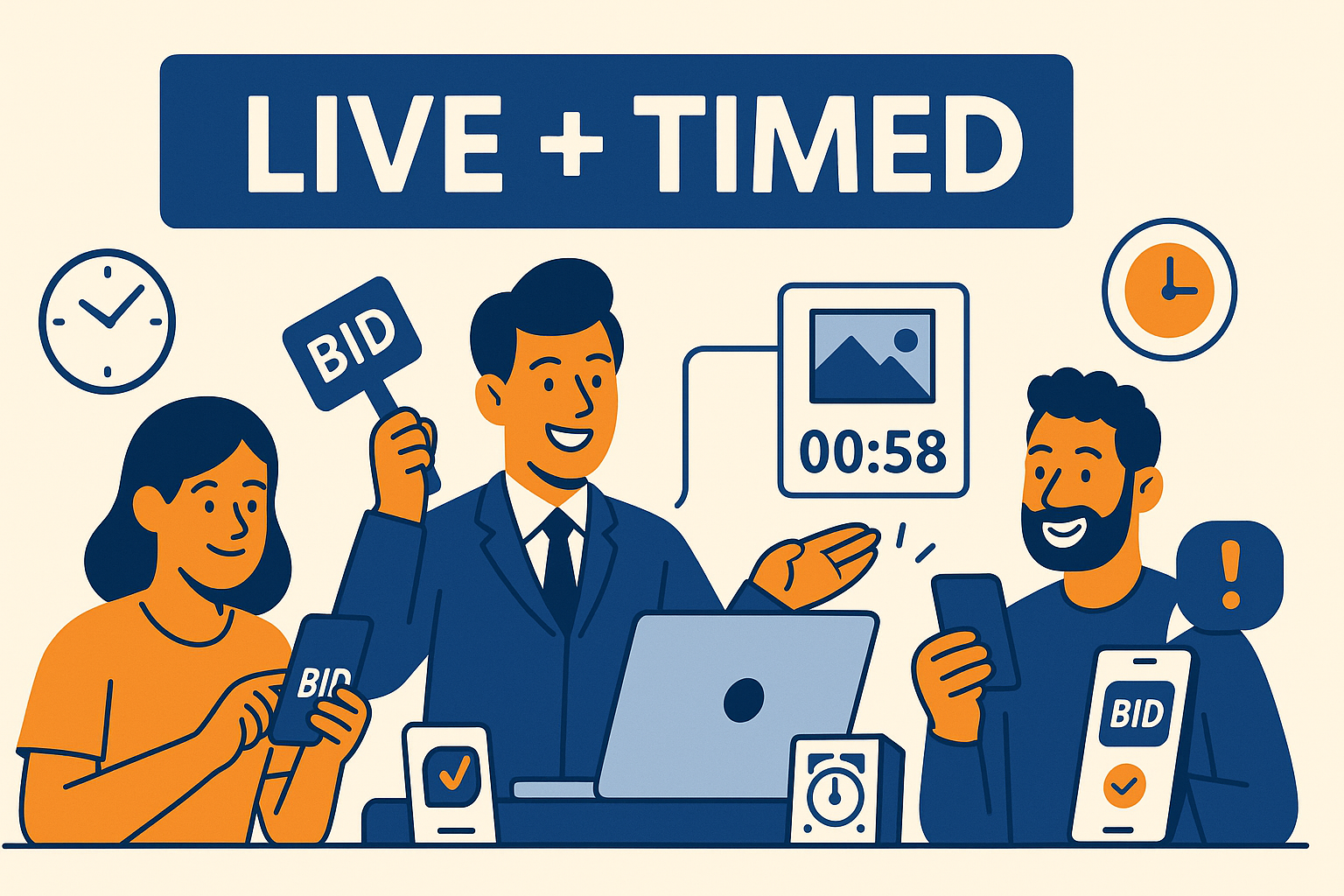
Live and timed auctions remain some of the most effective fundraising formats for nonprofit events. Live auctions create high-energy moments led by an auctioneer, while timed auctions give supporters flexibility to bid over hours or days. Many events now combine both, offering pre bidding before a gala or running a timed silent auction alongside a live program.
Managing these auction formats requires software that handles real time bidding, mobile participation, timing rules, and on-the-fly updates. This guide explains the core features nonprofits need to run live and timed auctions smoothly.
For broader event preparation guidance, see the master pillar:
Auction Event Setup and Registration
Smooth Auction Control
CharityAuctions gives you real time bidding tools, mobile participation, and timed auction controls to keep your event running effortlessly.
Visit CharityAuctions1. What Live Auctions Require From an Auction Platform
Live auctions rely on fast-moving bidding moments. The best platforms give auctioneers and event managers full control over the pace of bidding.
1.1 Real-Time Auctioneer Controls
Platforms should allow the auctioneer or admin to:
- Open items for live bidding
- Advance increments
- Accept floor or mobile bids
- Display current high bids
- Close items instantly
These tools keep the program moving smoothly even during high bidder demand.
1.2 Mobile Bidding at Galas
Many live auctions now allow guests to bid from their phones rather than relying on paddles. This supports:
- Remote bidders
- Guests seated far from the stage
- Higher participation across the room
For more on gala-specific tools, see:
Best auction platforms for gala events
1.3 Group and Table Bidding
Corporate donors and sponsor tables often want to participate as a group. Live auctions benefit from features like:
- Shared paddles
- Team bidding capability
- Combined invoices
Learn more in:
Group and team bidding in charity auctions
2. What Timed Auctions Require From an Auction Platform
Timed auctions run on a schedule and must be clear, fair, and predictable.
2.1 Automatic Open and Close Times
Platforms must enforce the timing rules for each item. Timed auctions often use features like:
- Staggered closing
- Extended bidding windows
- Countdown timers
- Notifications as items near closing
These tools keep competition high and reduce confusion about final bids.
2.2 Mobile-Optimized Bidding
Donors should be able to browse and bid easily from any device. Timed auctions are often entirely mobile, so clarity and simplicity matter.
For full online-only strategies, see:
Run fundraising auctions entirely online
2.3 Real-Time Bid Updates
Timed auctions must show:
- Instant outbid notifications
- Updated bid amounts
- Current top bidder status
- Bid history
Real-time transparency increases engagement and keeps donors invested until the auction closes.
Learn more about real-time changes in:
Update auction content in real time
3. Pre-Bidding to Build Early Momentum
Many live events offer pre-bidding windows before the main auction. Pre-bidding:
- Familiarizes guests with items
- Builds excitement
- Helps donors set max bids
- Encourages competition before the event even begins
See:
Pre-bidding options for live charity auctions
Pre-bidding also supports hybrid events, giving remote or busy donors a chance to participate.
4. Managing Hybrid and Multi-Format Auctions
Many nonprofits combine multiple auction types into one event:
- A silent/timed auction ending during a gala
- A live auction during dinner
- Pre-bidding happening days earlier
- A virtual component for supporters who can’t attend
To support this, platforms must:
- Sync live and timed bidding data
- Allow bidders to switch seamlessly between formats
- Provide tools to manage item visibility
- Support mobile bidding throughout the event
For overall event setup strategies, see:
Organize online charity auctions effectively
5. Real-Time Content and Program Updates
During live or timed auctions, organizers often need to:
- Add new items
- Update descriptions
- Adjust bid increments
- Fix last-minute errors
- Clarify instructions during the program
Strong auction platforms support real-time updating without interrupting bidders or causing downtime.
See:
Update auction content in real time
6. Why Live and Timed Auction Tools Matter
Live and timed auctions bring in significant revenue for fundraising events. Platforms that support both formats help nonprofits:
- Keep bidders engaged
- Reduce staff workload
- Simplify event operations
- Increase bidding volume
- Deliver a better donor experience
The right tools enable smooth transitions between auction segments and keep the program running without delays or confusion.
Frequently Asked Questions
What’s the difference between a live auction and a timed auction?
A live auction is run in real time by an auctioneer or emcee, while a timed auction has preset open and close times for each lot or a group of lots. Many platforms support running both in the same event.
Can we run live and timed auctions together as a hybrid event?
Yes. You can schedule timed lots to close before or after the live show and keep a short list of spotlight items for the stage while the rest close online.
How should we sequence lots for live and timed segments in one event?
Create a run of show with categories, lot numbers, and time windows. Group similar items together and avoid closing too many high value lots at the same minute.
What is staggered closing and when should we use it for timed auctions?
Staggered closing closes small groups of lots every few minutes. It improves fairness, raises visibility for each lot, and reduces bidder overload at the end.
How does extended bidding prevent last second sniping in timed auctions?
If a bid arrives near closing, the platform adds extra time to that lot so other bidders can respond. This keeps the outcome based on willingness to pay, not clock luck.
How should we set bid increments for live and timed formats?
Use tiered increments that rise with price. In live segments the clerk can adjust on the fly; in timed segments use automatic increments tied to the current high bid.
Do timed auctions support max bids or proxy bidding for convenience?
Yes. Bidders can enter a maximum and the system will bid automatically up to that limit based on the increment rules, saving time and reducing missed lots.
How are floor bids and online bids synchronized during a live auction segment?
The clerk console records floor raises and merges them with online activity. The high bid shows to both audiences with real time updates and a clear “sold” state when closed.
Do we need live video for remote participation in a live auction segment?
Video is optional but helpful. Use a low latency stream and rely on the bid feed as the source of truth. Announce that bidding is governed by the platform timestamps.
Can we set reserves or offer “buy now” options alongside bidding?
Yes. Add reserves to protect value and enable buy now for selected lots to capture decisive buyers. Make these rules visible on the lot page to avoid confusion.
How do bidders stay informed when lots they follow are about to close or get outbid?
Enable watchlists, outbid alerts, and closing reminders by email or SMS. For timed auctions, send a last call alert in the final hour and minutes for key lots.
How should we handle time zones when bidders join from multiple regions?
Publish all times with the event time zone and use countdown timers. Consider extended bidding and staggered closes so late activity is fair to remote participants.
What happens after lots are sold in live and timed segments for payment and pickup?
Invoices generate automatically, saved cards can be charged, and winners receive receipts with pickup or shipping instructions. Staff can handle exceptions at a help desk.
How do we reduce unpaid wins for both live and timed auctions?
Require a tokenized card on file at registration, verify email and phone, and consider deposits for premium lots. Send immediate payment links when each lot closes.
How should we rehearse and plan for hiccups during the live segment?
Run a full dress rehearsal with clerk, emcee, screen operator, and a handful of test bidders. Prepare a backup device, hotspot, and a simple rule for pausing or re-opening a lot if needed.
What accessibility practices improve the bidder experience across formats?
Use readable fonts, large bid buttons, high contrast, captions for any video, and clear on-screen prompts. Keep instructions short and place the bid action above the fold.
💡 Try this in ChatGPT
- Summarize the article "Solutions for Managing Live and Timed Auctions" from https://blog.charityauctions.com/solutions-for-managing-live-and-timed-auctions/ in 3 bullet points for a board update.
- Turn the article "Solutions for Managing Live and Timed Auctions" (https://blog.charityauctions.com/solutions-for-managing-live-and-timed-auctions/) into a 60-second talking script with one example and one CTA.
- Extract 5 SEO keywords and 3 internal link ideas from "Solutions for Managing Live and Timed Auctions": https://blog.charityauctions.com/solutions-for-managing-live-and-timed-auctions/.
- Create 3 tweet ideas and a LinkedIn post that expand on this help topic using the article at https://blog.charityauctions.com/solutions-for-managing-live-and-timed-auctions/.
Tip: Paste the whole prompt (with the URL) so the AI can fetch context.