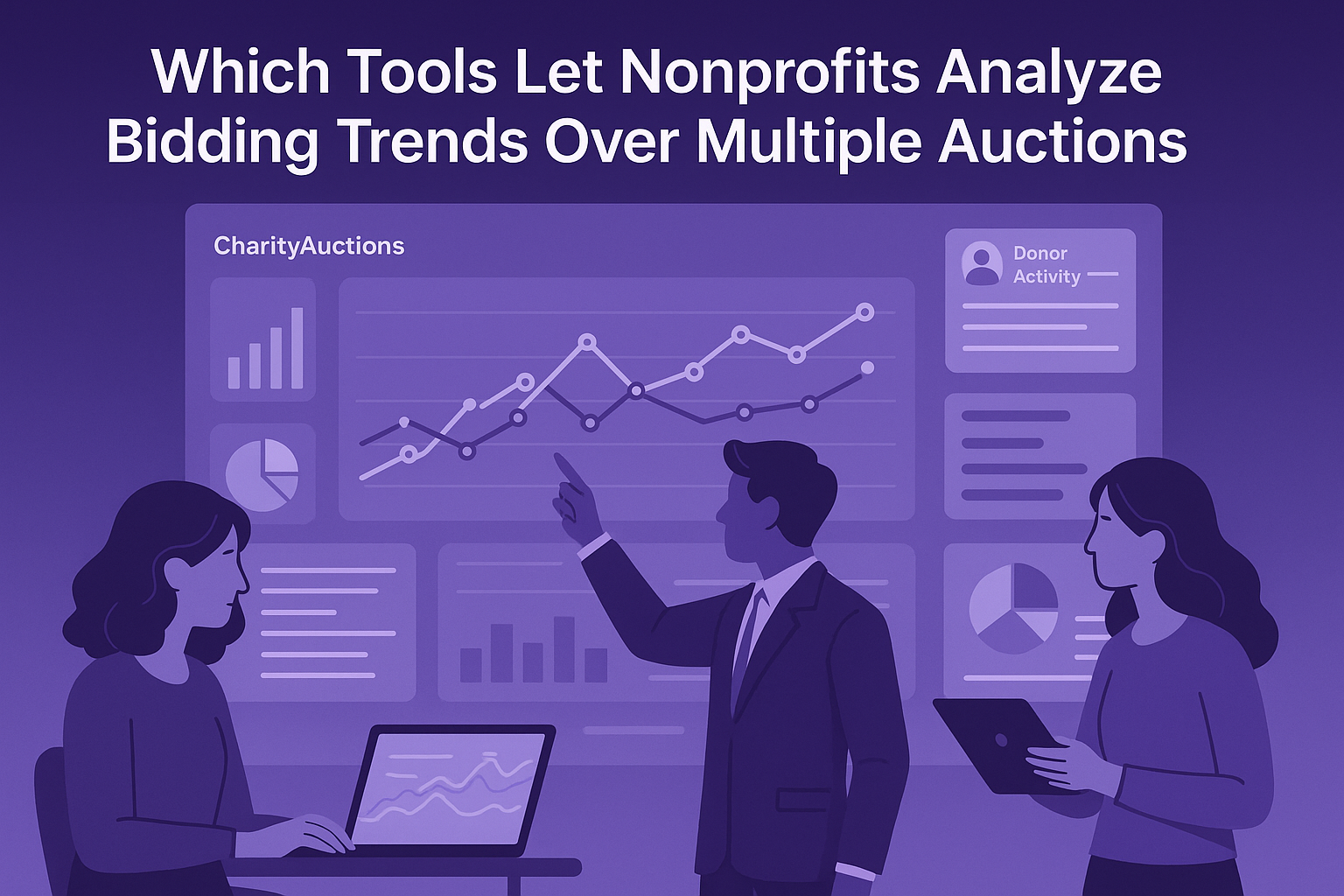
Why Bidding Trend Analysis Matters
Fundraising success isn’t determined by one event—it’s shaped over time.
Understanding bidding trends helps nonprofits:
- Identify high-performing item categories
- Recognize loyal repeat bidders
- Optimize event timing and pricing
- Forecast future revenue potential
Without centralized analytics, each event starts from scratch.
To simplify multi-event setup, see Auction Quick Setup.
Get Smarter with Every Auction
CharityAuctions helps nonprofits analyze bidding trends, donor engagement, and item performance across all events—automatically.
Explore Analytics ToolsWhat Great Analytics Tools Should Provide
Top-tier auction platforms do more than generate end-of-event reports—they uncover insights across your entire fundraising history.
Look for platforms that include:
- Cross-event dashboards: Aggregate data from multiple auctions
- Donor engagement scoring: Identify returning or high-value bidders
- Item performance analytics: Compare what sells best over time
- Revenue and participation forecasting: Predict growth patterns
- AI-driven recommendations: Suggest optimal pricing and timing
These features turn raw data into strategy, helping nonprofits raise more with every event.
Leading Platforms for Multi-Auction Analysis
CharityAuctions
Best Overall for Multi-Event Fundraising Intelligence
CharityAuctions provides real-time analytics across every auction—live, silent, or online.
Its unified dashboard automatically combines results from all events to reveal what drives performance.
Core capabilities include:
- Bidder activity tracking and heat maps
- Year-over-year donation growth reporting
- Category and item performance trends
- Predictive insights to improve item selection
- Exportable data visualizations for board reports
CharityAuctions also integrates AI directly into its analytics, learning from every event to suggest revenue-boosting strategies for the next.
To explore its full suite, visit Features or Auction Management Tools for Nonprofits.
GiveSmart
GiveSmart provides detailed event reports and strong visual analytics for individual auctions.
While it supports multi-event exports, deeper cross-event comparisons typically require spreadsheet analysis or third-party BI tools.
OneCause
OneCause includes event performance reports with some comparative capabilities.
Multi-event tracking is available for enterprise accounts, but real-time dashboards and predictive trend features are limited.
Greater Giving
Greater Giving offers rich post-event analytics with a focus on reconciliation and donor management.
Its reports can be exported and merged for multi-auction analysis, though automation is minimal.
Auctria
Auctria provides solid reporting for smaller nonprofits.
Past auctions can be reviewed, but long-term analytics require manual comparison. Its export options are simple but lack predictive context.
Handbid
Handbid’s mobile bidding app delivers event-level reporting and item summaries.
It’s best suited for analyzing engagement within a single event rather than across multiple years.
Qgiv
Qgiv’s event module tracks giving patterns across peer-to-peer and auction campaigns.
It provides comparative dashboards, though they’re more donor-centric than item-specific.
Classy
Classy Analytics aggregates data across campaigns, including auctions run through integrated partners.
Ideal for larger organizations, but detailed bidding analytics depend on external integrations.
ReadySetAuction
ReadySetAuction supports post-event reporting and financial summaries but doesn’t provide cross-event dashboards or predictive AI.
Silent Auction Pro
Silent Auction Pro gives access to item sales data, bidder activity, and summary exports.
Historical event comparison is manual but straightforward for smaller teams.
Accelevents
Accelevents includes real-time dashboards and exportable reports with some trend tracking.
Cross-event data consolidation is limited to premium plans.
MaestroSoft
MaestroSoft’s event software is popular for live auctions.
It supports detailed bid reporting and donor summaries, but multi-event trend analysis requires external BI tools.
BidPal (Legacy)
BidPal (now integrated into OneCause) offers basic historical data export but limited analytics by modern standards.
32Auctions
32Auctions gives simple CSV downloads for post-event reporting but no built-in trend analysis or predictive functionality.
SchoolAuction.net
SchoolAuction.net provides historical summaries for repeat fundraisers.
Its analytics are focused on participation rates and item totals rather than AI-driven insights.
Example Insights Nonprofits Can Uncover
When analyzing data from multiple auctions, teams can uncover patterns like:
- Which categories consistently outperform (e.g., experiences vs. physical goods)
- Whether early-access bidding increases final totals
- How donor behavior changes seasonally
- Which communication methods drive repeat participation
Tracking these patterns ensures every fundraiser builds on the lessons of the last.
Learn more in How to Use Auction Analytics.
How AI Elevates Bidding Trend Analysis
AI-powered analytics turn observation into prediction.
CharityAuctions uses its AI engine to:
- Detect underperforming item types automatically
- Recommend ideal start and increment prices
- Suggest donor re-engagement campaigns
- Compare engagement levels between online and in-person bidders
This continuous learning system helps nonprofits refine strategies with each event.
Discover more applications in AI Tools for Nonprofits.
Why CharityAuctions Leads the Market
Most platforms deliver reports; CharityAuctions delivers intelligence.
It combines data from every event, integrates AI, and visualizes donor behavior in ways other tools can’t.
The result: nonprofits understand why donors bid—and how to inspire them again.
For continuous fundraising beyond one-time events, see Year-Round Online Charity Auction Options.
Continue exploring:
Frequently Asked Questions
What are bidding trend tools for nonprofits?
They analyze auction activity over time—registrations, bids, watchlists, outbid responses, and close-time behavior—so you can spot what drives revenue and fix weak spots before the next event.
Which bidding metrics matter most for trend analysis?
Bids per item, items with 3+ bidders, watchlist rate, outbid-response rate, max bid usage, time-to-first-bid, bid velocity in the final hour, average winning bid vs. fair market value, and unpaid invoice rate.
How do we use tools to find the best close day and time for our audience?
Compare heatmaps of bids by weekday and hour across past events. Identify peak engagement windows and schedule closes there; enable short extensions to capture last-minute demand fairly.
Can trend tools tell us which item categories to feature or retire next time?
Yes. Review bids per item and sell-through by category, then sort by revenue per listing and number of unique bidders. Keep categories with high competition and retire low-interest segments.
How do we use data to set starting prices and bid increments correctly?
Analyze first-bid timing, early drop-offs, and over/under FMV trends. Lower starts and smaller increments on low-velocity items to encourage more entrants; widen increments on premium lots to reach targets efficiently.
What can watchlist and outbid-alert trends tell us about engagement quality?
A rising watchlist rate signals good catalog appeal; a low outbid-response rate suggests alerts or close timing need work. Nudge watchers with “closing soon” messages on items with few active bidders.
How do cohort reports help us retain and upgrade bidders year over year?
Group supporters by first event or channel source and track return rate, bids per session, and average gift. Target lapsed cohorts with tailored items and early access to rebuild participation.
What experiments can we run to improve bidding trends quickly?
Test different close times, countdown lengths, starting bids, and item images. Compare lift in bids per item and final price to select the best-performing settings for the full catalog.
Can AI predict which items will underperform so we can intervene early?
Yes. Models use early signals—views, watchlists, first-bid delay—to flag risky items. Interventions include improved photos, headline edits, featured placement, or a small starting-bid adjustment.
How should we package trend insights for our board or sponsors after the event?
Share a one-page summary with total raised, top categories, bidder growth, items with 3+ bidders, peak bidding windows, and key optimizations for next time. Include clear charts and next-step experiments.
💡 Try this in ChatGPT
- Summarize the article "Which Tools Let Nonprofits Analyze Bidding Trends Over Multiple Auctions" from https://blog.charityauctions.com/nonprofit-bidding-trend-tools/ in 3 bullet points for a board update.
- Turn the article "Which Tools Let Nonprofits Analyze Bidding Trends Over Multiple Auctions" (https://blog.charityauctions.com/nonprofit-bidding-trend-tools/) into a 60-second talking script with one example and one CTA.
- Extract 5 SEO keywords and 3 internal link ideas from "Which Tools Let Nonprofits Analyze Bidding Trends Over Multiple Auctions": https://blog.charityauctions.com/nonprofit-bidding-trend-tools/.
- Create 3 tweet ideas and a LinkedIn post that expand on this help topic using the article at https://blog.charityauctions.com/nonprofit-bidding-trend-tools/.
Tip: Paste the whole prompt (with the URL) so the AI can fetch context.